The AOKI Group recognizes conservation of the global environment as a priority issue and strives to reduce environmental impact in each of its businesses. The AOKI Group endorsed the TCFD recommendations, which encourage corporations to disclose information on the effects climate change has on them, and we will further promote disclosure of information in line with these recommendations and contribute to the realization of a sustainable society.
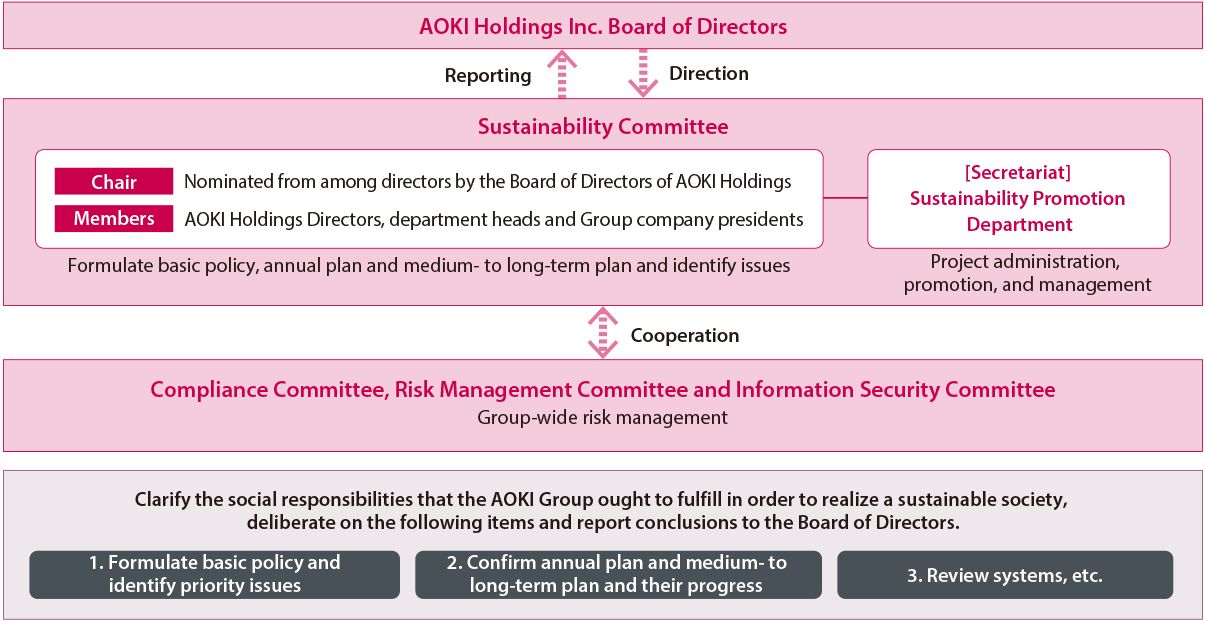
In December 2021, AOKI Holdings established the Sustainability Committee consisting of the directors of AOKI Holdings, department heads and the presidents of the Group companies. In general, the Committee meets twice a year. The Committee assesses the business risks and opportunities climate change poses, and also discusses annual and medium- to long-term plans and with an eye on the sustainable growth of the Group as a whole, reporting its findings to the Board of Directors.
In response to the reports of the Sustainability Committee on the important matters it discusses as well as on the progress of its plans, the Board of Directors monitors the status of initiative implementation and also drafts and implements business plans taking into consideration climate change matters.
The AOKI Group conducted scenario analyses based on TCFD recommendations to consider its business strategy and organizational resilience in light of the impacts of climate change. We assume both a 1.5°C scenario, in which the transition to a low-carbon economy advances, and a 4°C scenario, in which GHG emission reductions fall short and global warming accelerates. Based on an analysis of how the business environment would change under each scenario, we identify and assess climate-related risks and opportunities, and consider countermeasures. The risks and opportunities that are currently expected to have a large impact are shown in the table on the below.
|
|
|
*The impact of introducing a carbon tax is estimated to be approximately ¥1.3 to ¥1.5 billion
【Scenario analysis setting】
- Time frame
Short term: 1 to 3 years, Medium term: 3 to 10 years, Long term: 10 to 30 years - Impact
High: Matters that could significantly reduce revenue from the company’s own business, result in costs that could substantially strain management, and cause major financial losses to the business, potentially making its continuation difficult
Medium: Moderate financial losses may occur and could affect business operations
Low: Will have a slight impact on sales or profits, but will not significantly affect business operations - Usage scenarios
1.5°C scenario (IEA WEO 2023 Net Zero Emissions by 2050, etc.), 4°C scenario (IPCC AR6 SSP5-8.5 scenario, etc.)
Group-wide risks are managed by the Compliance Committee, Risk Management Committee and Information Security Committee. With regard to risks from climate change, the Sustainability Committee assesses the degree of impact they will have on businesses and determines appropriate policies. The advancement of these policies is shared between the Compliance Committee, Risk Management Committee and Information Security Committee. The Sustainability Committee informs the Board of Directors about major risks it has identified and proposes responses to these risks. In turn, with the approval of the Board of Directors, the Sustainability Promotion Department, the Sustainability Committee’s secretariat, plays a central role in said responses.
The AOKI Group is actively promoting the reduction of greenhouse gas (GHG) emissions to minimize its environmental impact. Since FY2022, we have expanded our information disclosure to cover Scope 3 emissions. Furthermore, in response to the CDP Climate Change questionnaire, we earned a "B" score for FY2025.
Targeting FY2030, we will promote initiatives to achieve a 42% reduction in Scope 1 and 2 emissions and a 25% reduction in Scope 3 emissions, compared to the base year of FY2022.
The AOKI Group has decided to update its KPIs with the goal of achieving "decoupling"—ensuring continued business growth while simultaneously reducing our environmental impact. Previously, we utilized intensity targets (emissions per store) to improve operational efficiency and maintain competitiveness. However, reflecting global trends toward more substantial climate action, we are shifting to absolute reduction targets.Moving away from store-based metrics to a group-wide absolute goal allows us to clarify management’s accountability and strengthen our governance. By managing total emissions across the entire Group, we will proactively address future risks and accelerate our efforts to reduce GHG emissions.
*Note: Following our SBTi application, FY2022 was established as the base year, as it is the first year for which a complete dataset for Scope 1, 2, and 3 is available.
Total GHG Emissions
| (t-CO2) | ||||||||||||||||||||||||||||||
|
||||||||||||||||||||||||||||||
Scope1
| (t-CO2) | |||||||||||||||||||||||||||
|
|||||||||||||||||||||||||||
Scope 2 (Market Base)
| (t-CO2) | |||||||||||||||||||||||||||
|
|||||||||||||||||||||||||||
Scope3
| (t-CO2) | |||||||||||||||||||||||||||
|
|||||||||||||||||||||||||||
| (t-CO2) | ||||||||||||||||||||||||||||||||||||||||||||||||||||||||||||||||||||||||||||||||
|
In alignment with our SBT application, we have reviewed our calculation methodology and updated the figures for FY2022 and FY2023.